

Let Fintech Grow · Webinar
Tales from the Fintech Graveyard: An LFG! Halloween Special
We gathered a panel of founders to talk about the businesses and ideas that didn’t make it. You can watch the whole webinar here.
On 30 October, LFG! hosted its first-ever webinar. David Barton-Grimley and I invited three fintech leaders to share personal stories about the times they got things horribly wrong, and what they learned.
When I sent the invitations, I wondered whether anyone would want to talk about their mistakes in public. They all did, and there’s plenty to learn from what they shared. Sometimes you learn more from the mistakes than you do from the successes.
A vision the banks weren’t ready for
David, a long-time host of the Fintech Insider podcast and most recently head of product at Cleo, opened with a howler of his own. He set up his first business in 2008, aged 21, working on credit card rewards and merchant funding in Southeast Asia.
Back then, card rewards came as a book of deals that customers redeemed with a clunky form or a phone call. David pitched banks on an app that would use customer data to personalise offers, which customers could take up at the press of a button. The traction was real: at one point, he was working with almost every major bank in the region.
But the banks wanted something different. Rather than pivot, David sold them the websites and CRM systems they asked for at a discount, believing the business would eventually reach his vision. He later ended up running three startups at the same time, something that he now advises against. But his first business, which turned into a consulting firm, is still running almost 15 years later, with the management team he hired.
“Always remember: the customers that you have and the products that you have are not necessarily the vision that you have,” he said.
Carrie Osman and the founder’s desert
Carrie, CEO and Founder of growth intelligence specialist Cruxy, came to fintech from consumer goods. In the 12 years since she started the firm, Cruxy has worked with more than 100 fintech businesses, but here she described a period as a founder that could only be called a desert, or, to stay on theme, Night of the Living Dead.
It started with advice. “It’s crazy, when you start a company, the number of people that circle you and want to give you advice,” she said. Much of it came from people who had never started or risked anything. It pushed her towards hiring and scaling, and her standards started to slip. She hired people in the hope that they would change, even after they had shown they wouldn’t.
She was also early. Carrie believes pricing should be set through the lens of product value, an idea companies are only now coming round to as AI forces them to rethink what makes their products valuable. When she built Cortex, which Cruxy now calls a value capture platform, nCino was excited by it, but plenty of other people thought she’d lost her mind.
The stress was intense. At one point she called 111 about heart palpitations, and an ambulance was sent to her house. Revenue of around £800,000 was just enough to stop her from quitting. “You don’t give up on eight hundred grand. You give up on two hundred grand,” she said. “But it was brutal.”
Two graves and a grave robber
Shalom Osiadi, CEO and Founder of Esca, took us back to the business that came before Esca Finance: a food delivery platform in Nigeria that connected home chefs, and later restaurants, with local customers. Mistake number one was believing that about £120,000 would be enough to scale a food delivery business in a saturated market.
To stand out, the team offered restaurants a share of its fees as cashback in USDT, USDC and Bitcoin. In 35 days, the platform went from 10 restaurants to 160. But there were plenty of orders and hardly any deliveries. Restaurants were ordering from themselves to earn the cashback, and using it to protect their revenue from the falling naira, which Shalom said went from something like 300 to the dollar to around 1,800.
“I thought raising just about £120,000 was going to be enough to scale a food delivery platform. Big, big, big mistake.”
So the team killed food delivery and focused on hedging. It partnered with what was then the second-largest fintech in the country and installed its software on the partner’s point-of-sale machines. That worked for a long time, until the partner copied the idea and scaled it out for itself. Two graves, and a grave robber. RIP, Esca Menu.
Luckily, Esca had enough runway, users and a great team to keep building. Today, Esca Finance is a hedging and payments ecosystem that helps businesses in established and emerging markets protect their revenue against currency fluctuations and devaluation.
Conrad Ford and the book he didn’t read
Conrad, Chief Product & Strategy Officer at Allica Bank, founded Funding Options in the early 2010s, after working in corporate strategy at one of the big banks in Canary Wharf. Founders at the time were told to read The Lean Startup. Conrad decided his background meant he didn’t need to.
He spent a year building a platform that bombed, because it was the wrong platform. Two years in, his investors were losing patience, and he faced the crisis founders rarely admit to while they’re living it: can I pay the staff on Wednesday? “All because I was too arrogant, and I thought I knew it all because I had a corporate strategy background,” he said.
“Try having it weighing on your mind that ‘I might have to walk out on Tuesday afternoon and tell everyone they don’t have jobs, and they’re not going to get paid.’”
There’s a happy ending. Funding Options is now a thriving and very profitable subsidiary of Tide, and Conrad took the lessons with him to Allica. His advice for anyone leaving corporate life to build something: read the book and believe it, but don’t treat it as a holy text. “Every startup is great in a different way.”
He also recently discovered that The Lean Startup was only published a year or two before he founded Funding Options. “I didn’t screw up quite as much as I thought I had.”
When to pivot, and who to listen to
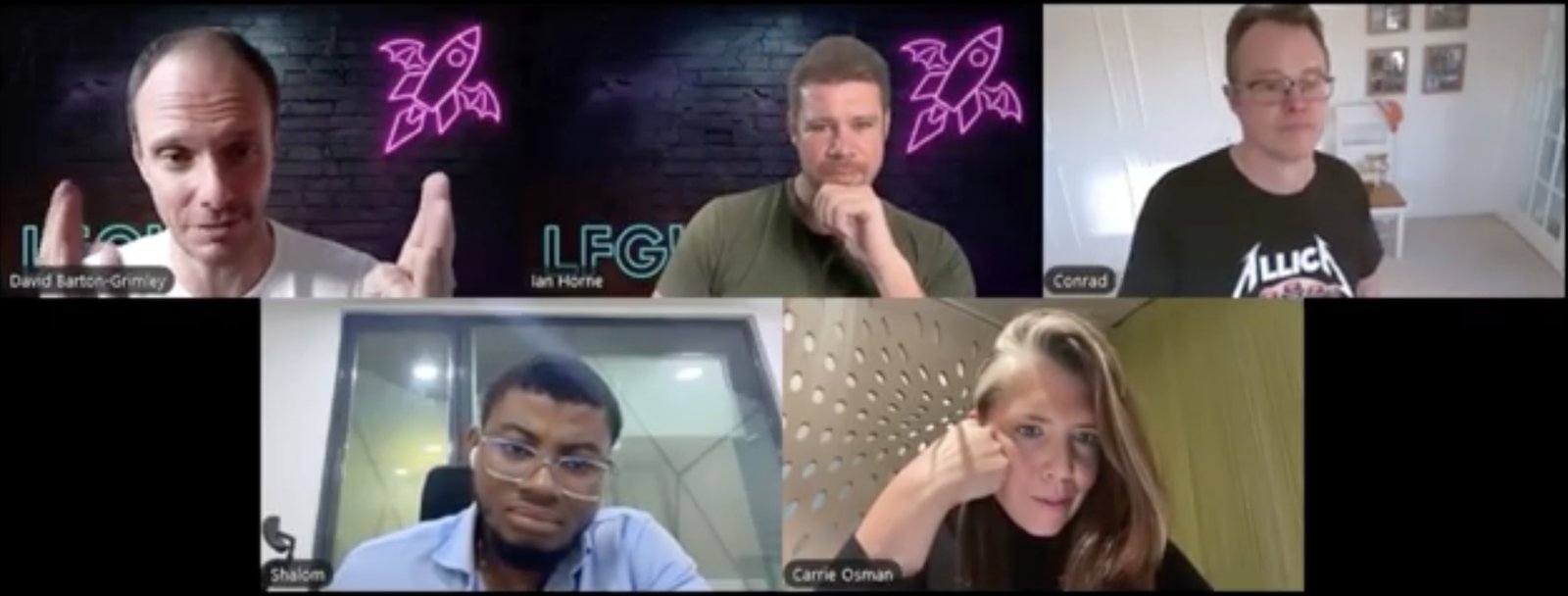
The panel discussion picked up where the stories left off. On pivots, Conrad borrowed a rule from yacht sailing: only step down off the boat. In other words, you only get into the life raft when the boat is lower than the raft. A full pivot is a big deal, because the team you hired was built for the business you set out to build. His own panicked changes of business model and brand at Funding Options, he said, “just cost me time and money”.
He prefers a line from Jeff Bezos: “We are stubborn on vision. We are flexible on details.”
Conrad warned that founders pivot far too often, but said Shalom’s story was the perfect example of when a full pivot is the right call. Shalom agreed that it wasn’t easy: his team had been hired to sell to restaurants and home cooks, and had to change once the business turned out to be somewhere else.
Carrie said she was “very bad” at taking advice during her desert. “I looked at everyone as if they were carrying a pail of water, even when they weren’t.” Now she asks what three things she would need to know to decide whether something is worth doing, and who has the specialist knowledge to help. Her advice: “Be a shark. Don’t stop.”
Conrad argued that he created his own desert by building a platform before signing up customers who would pay him. “The trick is to set off with the right provisions, and set off in the right direction.”
On spotting when something has gone wrong, Carrie said the setting matters. Feedback lands better on a Saturday walk and a coffee than slipped into a board meeting.
On communicating trouble, Conrad said you don’t necessarily share it. “Unfortunately, ‘fake it till you make it’ is to some extent a feature, not a bug, of startup land,” he said. He never told his team when he wasn’t sure he could pay them the following week.
But he said it’s important to have people you can tell the blunt truth to, and to be super honest with your board and investors once they’re on board. “They will respect you if you give them the unvarnished truth.” And never lie to potential investors. Nobody on the panel disagreed.
How to stay out of the graveyard
To finish, I asked each of them for one piece of advice.
- David: “Know what questions to ask: of people, of your investors, of your friends.”
- Shalom: “Don’t be too invested in what you thought your business was going to be.” Otherwise, he said, you could build yourself into the graveyard “with hopes and dreams rather than facts and figures”.
- Conrad: “Stubborn on the vision, flexible on the details.”
- Carrie: Building a company is harder than most people admit, so be careful who you listen to. “When people tell you that it shouldn’t be that hard, I often think they’re the people that have read a book but not actually delivered much.”
Thank you to Carrie, Shalom and Conrad for opening up, to David for co-hosting, and to Ryzon for sponsoring the webinar.